
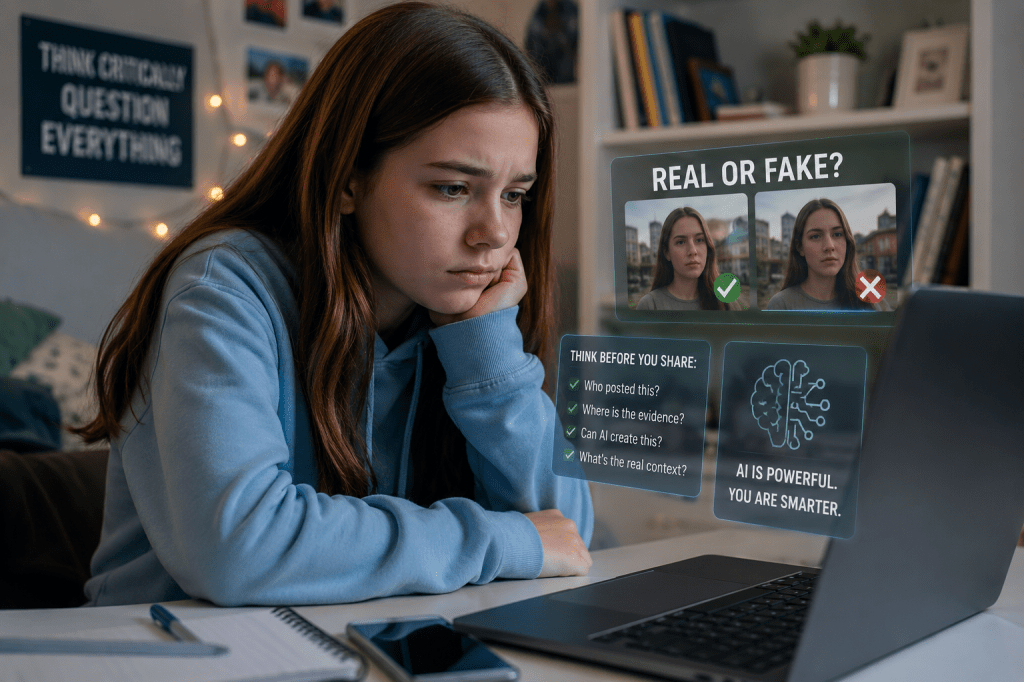
Just a few years ago, spotting misinformation often meant checking whether an article came from a trustworthy source or whether a photo had been edited. Today, artificial intelligence has changed the game. AI can generate realistic images, clone voices, create convincing videos, and even write persuasive social media posts within seconds. As these tools become more accessible, the question is no longer “Can AI create fake content?”—it’s “How do we know what to trust?”
This shift is changing how educators, policymakers, and technology experts think about digital citizenship. Around the world, schools are beginning to recognize that traditional media literacy is no longer enough. Instead, students must also develop AI literacy: the ability to understand how AI creates content, recognize its limitations, and think critically before believing or sharing what they see online.
The challenge isn’t just political misinformation. AI-generated content is increasingly affecting teenagers in their everyday lives. Schools have reported incidents involving AI-generated deepfake images of students, fake voice recordings, and fabricated social media posts that spread before anyone realizes they aren’t real. These situations demonstrate that AI misinformation isn’t simply an issue during elections—it has become a personal issue for young people.
What makes AI-generated content especially difficult to identify is that it often contains no obvious mistakes. Earlier forms of misinformation frequently included spelling errors, awkward editing, or low-quality images. Today’s AI tools can create polished content that appears authentic at first glance. Even experienced internet users can struggle to distinguish between real and AI-generated material.
This means our habits online must evolve. Instead of asking, “Does this look fake?” we should begin asking different questions:
- Who originally posted this?
- Can I find another reliable source reporting the same information?
- Does the image, video, or quote appear anywhere else?
- Is there evidence beyond what I’m seeing in a single post?
- Could AI have been used to create or manipulate this content?
Critical thinking has become more important than perfect detection. In many cases, even experts rely on additional context and verification tools rather than simply looking at an image or video.
The good news is that awareness is growing. More than half of U.S. states have now taken legislative action related to media literacy education, and many are expanding those efforts to include AI literacy in classrooms. Rather than teaching students only how to avoid misinformation, schools are beginning to teach them how AI systems work, how algorithms influence what appears in their feeds, and how to responsibly use AI themselves.
At Media Savvy Teens, we believe this is exactly the direction digital education needs to take. AI is not inherently harmful—it is an incredible tool for learning, creativity, and innovation. But like any powerful technology, it requires informed users. The goal should never be to fear AI. The goal is to become informed enough to question it.
As AI continues to shape our news, conversations, and social media feeds, one skill stands above the rest: curiosity. The students who pause before they share, verify before they believe, and question before they react will be the ones best prepared for the future.
Media literacy isn’t disappearing. It’s evolving. And in the age of artificial intelligence, becoming AI literate may be one of the most important skills our generation can develop.


Leave a Reply