
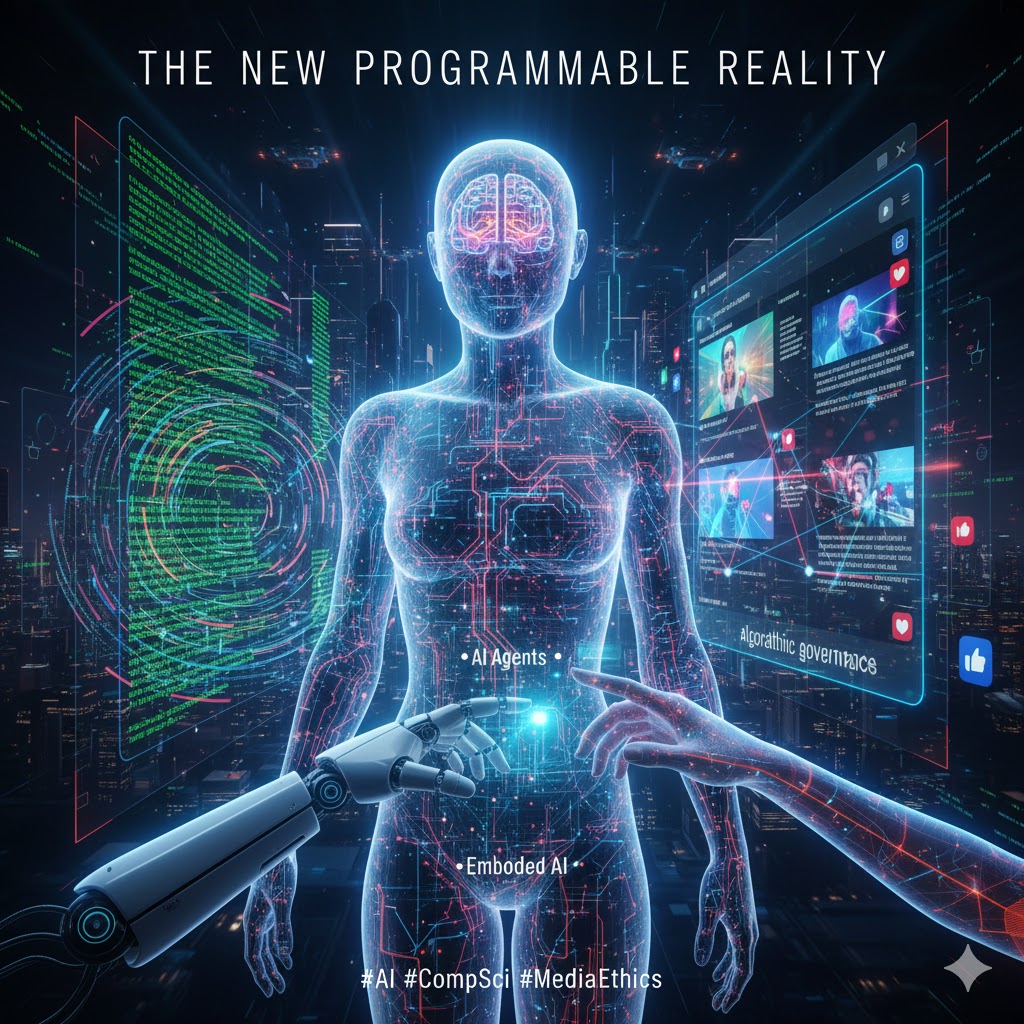
In the final weeks of 2025, the conversation around technology has shifted from “What can AI do?” to “How is AI restructuring the world we live in?” For anyone interested in computer science or media, we are no longer just consumers of content; we are witnesses to a fundamental “refactoring” of the digital landscape.
From the way code is written to the way information is filtered on your feed, the boundary between human intent and machine execution is dissolving. To be truly media savvy in 2026, you need to understand the three pillars of this new programmable reality.
1. The Abstraction of Code: From Syntax to Systems
In early 2025, tech circles popularized the term “vibe coding”—the idea of describing a functional requirement to an AI and letting it generate the thousands of lines of code needed to make it real.
However, as the year closes, industry leaders like Andrej Karpathy (founding member of OpenAI) are warning that this creates a new challenge. We are moving toward a “programmable layer of abstraction.” The skill is no longer just knowing Python or C++; it is knowing how to orchestrate AI Agents.
- The Shift: You aren’t just a “coder” anymore; you are a System Architect.
- The CS Reality: Debugging is becoming more complex because AI-generated code is “stochastic” (probabilistic and slightly unpredictable) rather than purely “deterministic” (following rigid, set rules).
2. Algorithmic Governance: The Science of the Feed
Media literacy is now inseparable from computer science. Every time you scroll, you are interacting with a neural network that has been trained on trillions of data points.
- Inference vs. Input: Platforms no longer just look at what you like; they use inference models to predict your mood, your political leanings, and your attention span.
- The “Black Box” Problem: A major topic for 2026 is Explainable AI (XAI). As these media algorithms become more complex, even the engineers who built them struggle to explain why a specific video was boosted. Being savvy means recognizing that your “For You” page is a mathematical output designed for retention, not a reflection of objective reality.
3. Embodied AI: Tech Entering the Physical World
We are seeing a pivot from AI that lives in a chat box to AI that lives in the physical world. This year’s breakthroughs in Humanoid Robotics and Neural Implants (like the latest BISC chips) show that computer science is moving back into hardware.
- The Media Impact: This creates a new category of “Synthetic Media.” When AI can control a physical robot or interpret human brainwaves, the “media” we consume will eventually become multi-sensory and immersive, moving beyond the 2D screen.
The Verdict: Knowledge is the Ultimate Firewall
The goal of studying AI and Computer Science isn’t just to get a job—it’s to maintain agency. When you understand how the model is trained, how the code is structured, and how the algorithm filters your world, you cease to be a “user” and start becoming an “operator.”
As we head into 2026, don’t just use the tools. Deconstruct them.
 Media Savvy Teens
Leave a comment